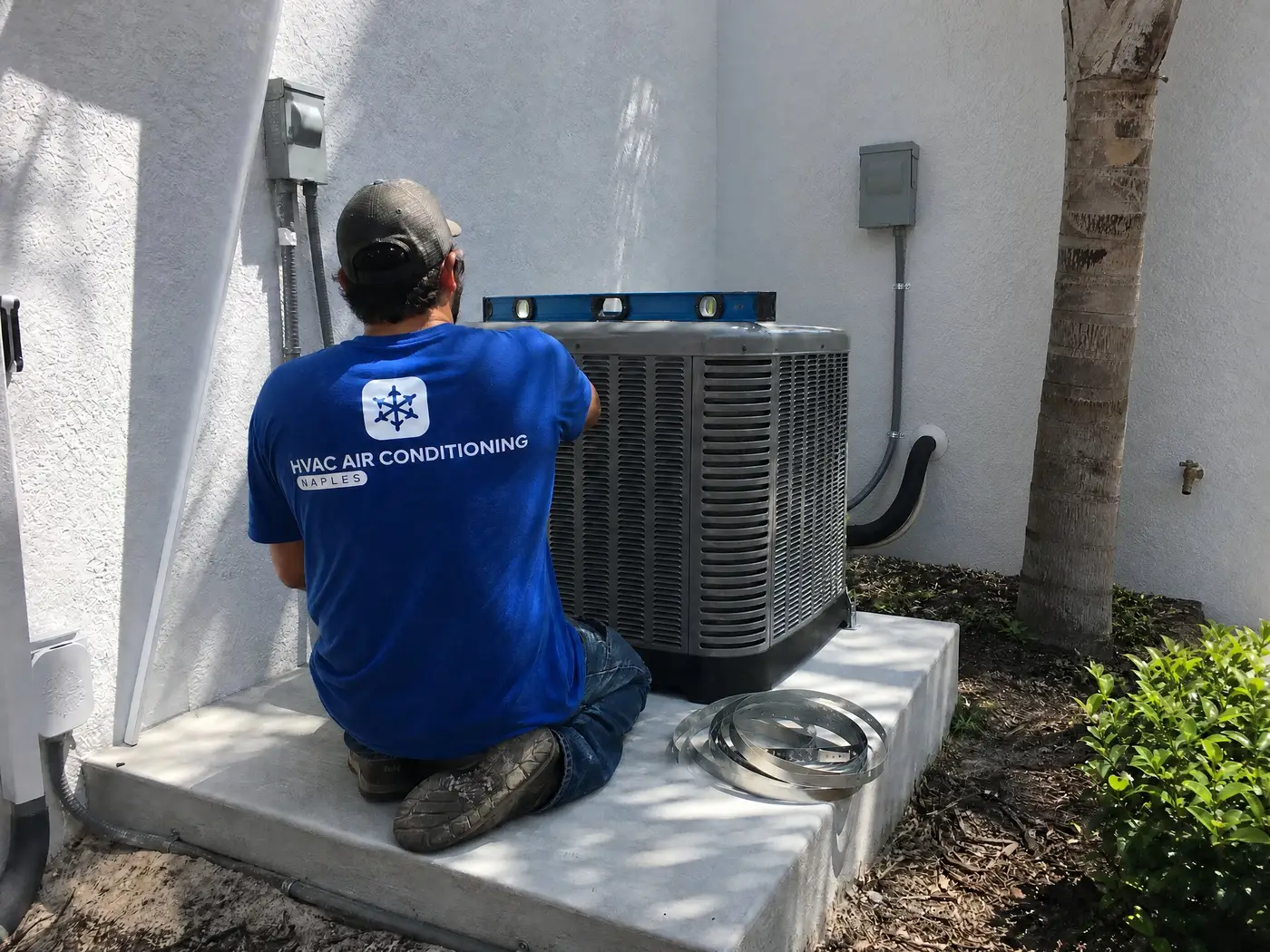
AC installation and replacement in Naples
We replace worn and salt-damaged systems and install new air conditioners, heat pumps and ductless mini-splits in Naples homes and condos. Each one is sized for the house, secured to its pad or stand, and tested before we leave.
When AC replacement in Naples makes sense
We don’t push replacement when a repair will do. A system is worth replacing when the repairs keep coming, when a corroded coil has started leaking, or when an R-22 system needs a major part and the refrigerant to go with it.
Salt changes the math near the Gulf. A manufacturer’s installation manual warns that salt spray in seacoast areas is especially corrosive and can shorten the equipment’s useful life, so a coastal unit and an inland unit of the same age are rarely in the same shape.
When you’re weighing it, we’ll walk you through what we found on the coil and the cabinet and give you a straight comparison of fixing the old system against replacing it.
Sizing a new system for the house
A bigger unit won’t cool a Naples house better. An oversized system cools the air fast, shuts off, and never runs long enough to pull the moisture out, which is how a house ends up cold and clammy at the same time.
Florida’s residential code requires cooling equipment to be selected with ACCA Manual S, based on loads calculated with ACCA Manual J. So the tonnage on the old unit’s label isn’t where we start. The house is.
Collier County pays attention to this as well. Changing the size of the equipment moves a replacement out of the county’s self-issued permit and into plan review.
What the rules say about new AC equipment
Two federal rules and a local permit shape every replacement in Collier County.
Efficiency minimums
Florida is in the Department of Energy’s Southeast region. Since January 1, 2023, a split central air conditioner installed here has had to reach at least 14.3 SEER2 below 45,000 Btu per hour, or 13.8 SEER2 at that size and above. Split heat pumps need 14.3 SEER2 anywhere in the country.
Refrigerant
EPA rules limit new home AC and heat pump equipment made since January 1, 2025 to refrigerants with a global warming potential under 700. R-410A rates 2,088, so new equipment uses lower GWP refrigerants. A 2026 EPA rule still lets R-410A equipment built before 2025 be installed while that stock lasts.
Permits
Collier County issues A/C replacement permits through its online portal. Inside the City of Naples and the City of Marco Island, the city’s own building department handles it. Florida’s 2026 exemption for small home projects does not cover mechanical work.
Hurricane straps and raised stands
Florida’s mechanical code requires outdoor equipment and its supports to be installed to resist the wind loads set by the building code. On a Naples install that means the condenser is fastened to its pad or stand with straps or anchors, not just set on it.
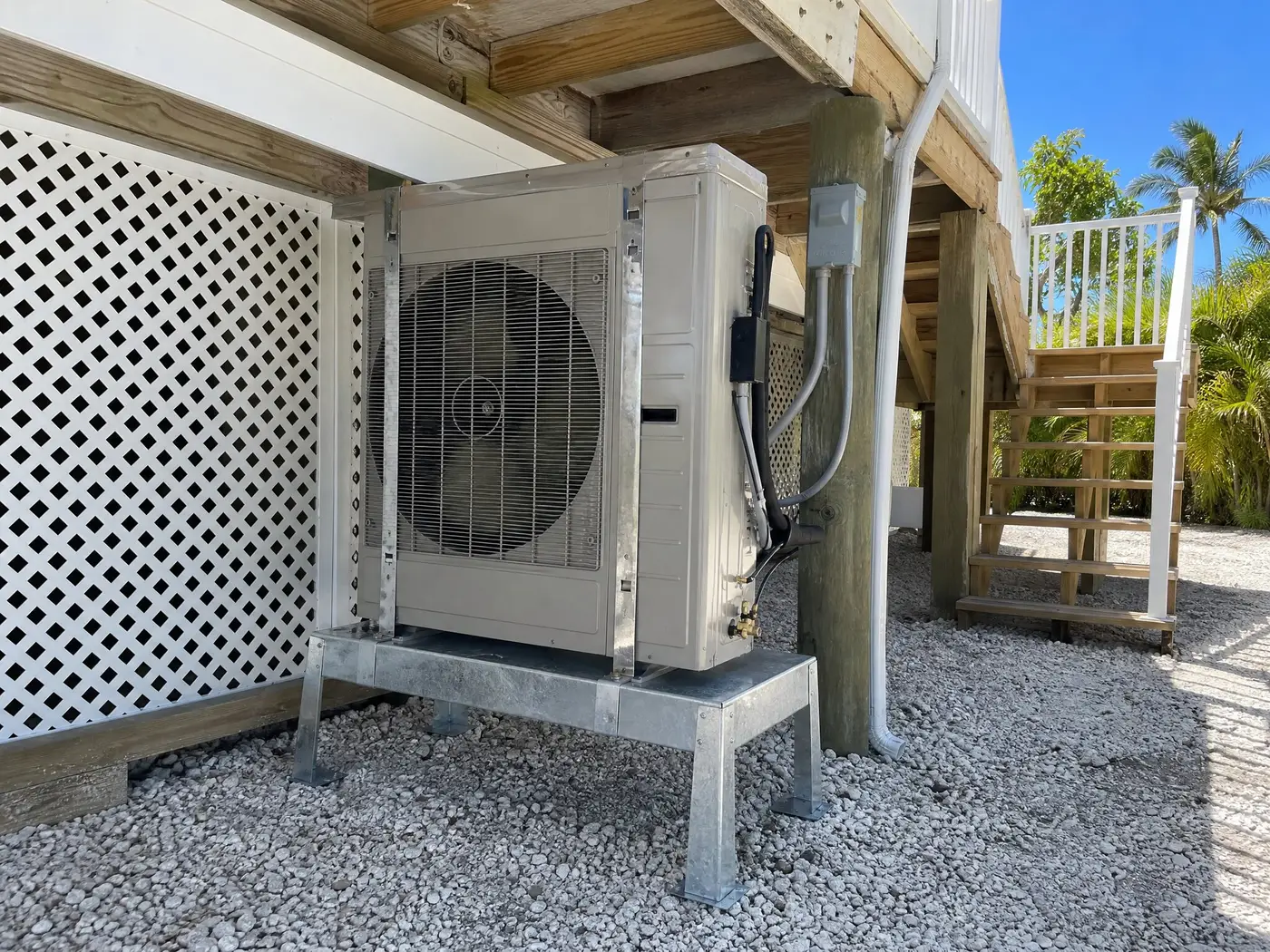
In a flood hazard area, the code also wants mechanical equipment at or above the height required for that site. On raised coastal homes we set the outdoor unit on a galvanized stand or platform that puts it there, with the line set and wiring supported along the way.
Your flood zone and the height it calls for come from the flood maps and the permit, and we confirm both before we order a stand.
The part of the install you don’t see
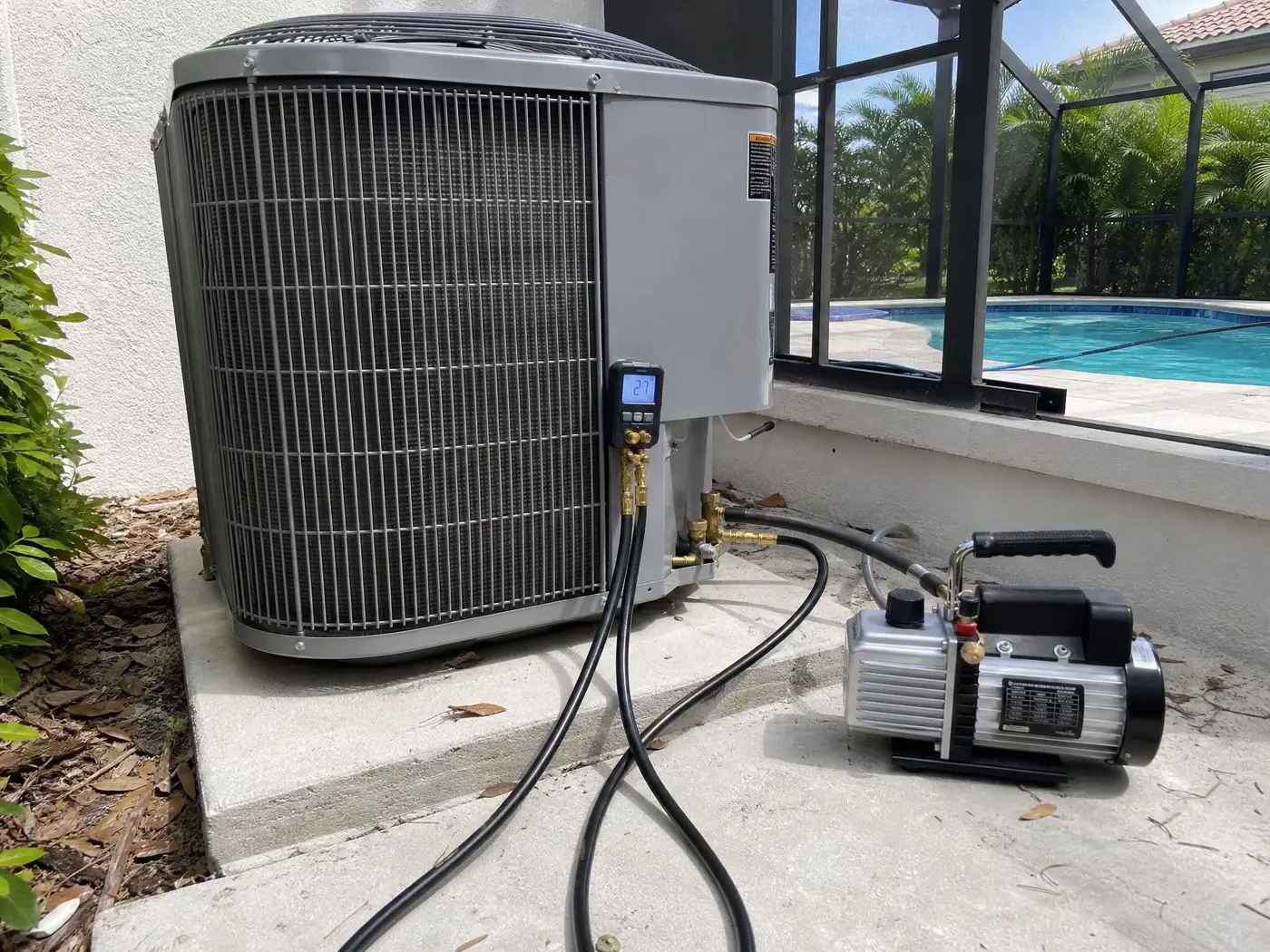
Before refrigerant goes into a new system, the line set and indoor coil have to be emptied of air and moisture. We connect a vacuum pump and a micron gauge and pull the system below 500 microns, then shut the pump off and watch the gauge to see whether the vacuum holds.
A reading that creeps back up means a leak or leftover moisture, and both are far easier to deal with now than after the system is charged.
It takes time. In our experience it’s also one of the first steps a rushed install skips.
How an AC replacement goes
Look and measure
We look at the house, the electrical, the drain and where the old equipment sits, and run the load calculation.
Options
You get the equipment we’d recommend, with what each option includes, so you can compare them side by side.
Permit
We file the permit with Collier County or with the city, depending on your address.
Out with the old system
The old refrigerant is recovered, not vented, and the old equipment leaves with us.
Set, connect and evacuate
New equipment goes in level and secured, the drain and float switch get connected, and the system is pulled into a deep vacuum.
Charge and test
We charge to the manufacturer’s specification, run the system, and check the temperatures and pressures and watch the drain before we leave.
Inspection
The building department inspects the work and closes out the permit.
Systems we install
Central AC and heat pumps
Split systems with an outdoor unit and an indoor air handler, matched to each other and to the house. Most Naples homes run a heat pump, which cools the same way an AC does.
Ductless mini-splits
For a garage, an addition, a sunroom or an older house without ductwork. The refrigerant lines need only about a three-inch hole through the wall.
Air handlers
Replaced on their own when the indoor coil or blower has failed and the outdoor unit still has life in it, or together with it when it doesn’t.
Coastal equipment
Several manufacturers sell coastal versions with coated or all-aluminum coils and heavier corrosion protection on the cabinet and hardware. For a home close to the beach, we’ll quote both.
Indoor air quality
Media filters, UV lights and whole-house dehumidifiers, if your house needs one. We’ll say so if it doesn’t.
No cooling? Call or text us.
Or open the chat button. Tell us what the system is doing and where the equipment sits, and we’ll set up a visit.
Related
AC repair
Warm air, frozen coils, water at the air handler, humming outdoor units and refrigerant leaks, in Naples homes and condos.
AC repair detailsAC maintenance
Coil cleaning, drain line clearing, electrical checks and a refrigerant check, with extra care for salt on coastal units.
AC maintenance detailsQuestions we get
Do I need a permit to replace my AC in Collier County?
Yes. Collier County treats it as an A/C replacement permit, and the City of Naples and the City of Marco Island issue their own inside city limits. Florida’s 2026 exemption for small home projects leaves out mechanical work, so it doesn’t apply to an AC change-out.
Can I still get an R-410A system?
Possibly. EPA’s 2026 rule lets R-410A equipment built before January 1, 2025 be installed until existing stock runs out, but equipment made since then uses lower GWP refrigerants. We’ll tell you what’s actually available when we quote the job.
Should I go up a size since the house runs warm?
Usually not. An oversized unit short cycles and leaves humidity behind. If the house runs warm, we’d rather find out why first, and the load calculation is part of that.
What happens to the old unit?
It leaves with us. We recover the refrigerant first, because federal law prohibits venting it.
Can you put a mini-split in my garage?
Yes, as a permitted install. In unincorporated Collier County a new mini-split goes through plan review with energy calculations for the newly cooled space, and we prepare that with the application.